
- July 22, 2026
- 1 views
- 0 Comments
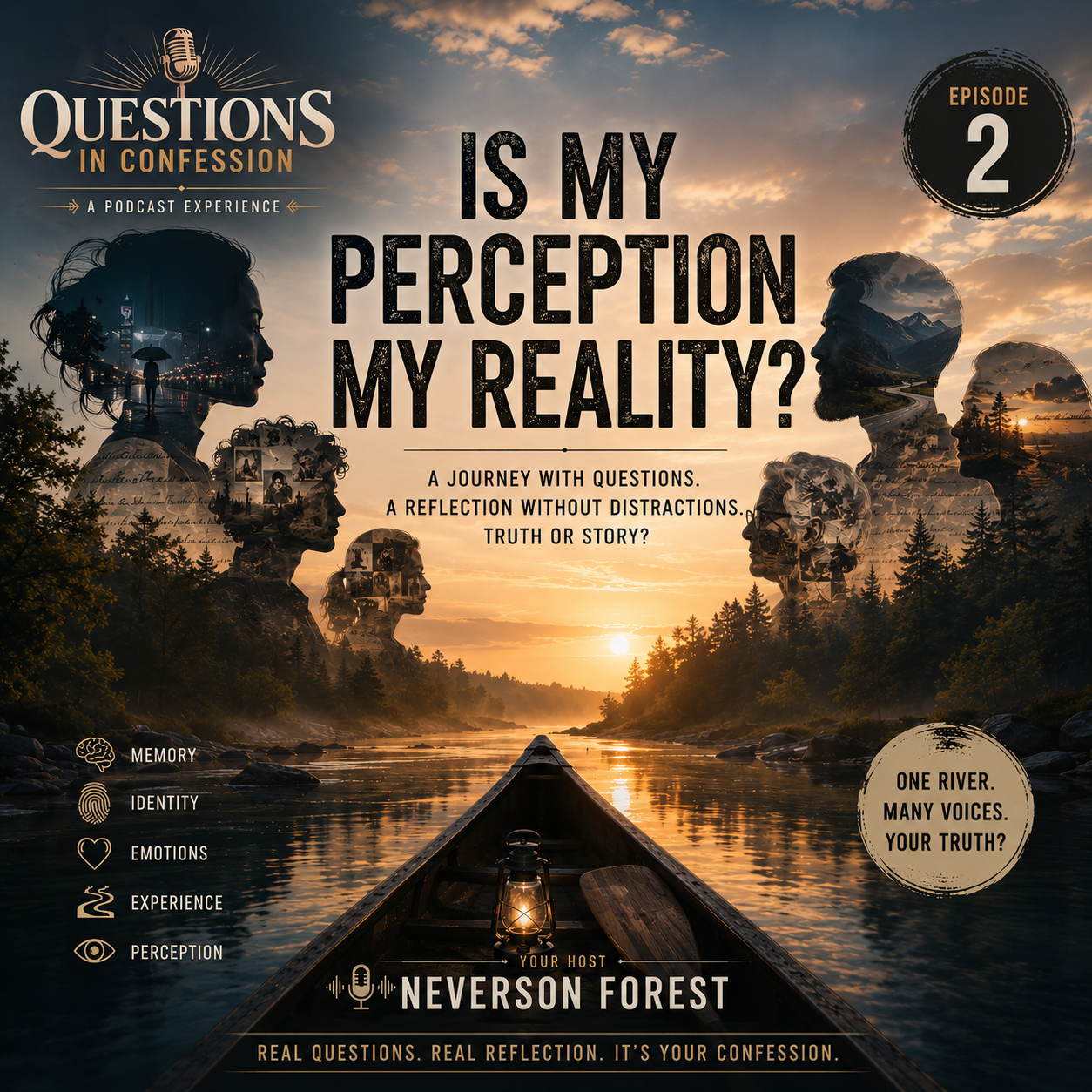
Hello. Today’s date is July 20, 2026, and I’m happy to be publishing the first question for this series, as well as setting the first pieces that will help to shape the identity of this show. Since the first opening episode, I have been researching and carefully designing the structure to meet my objectives for adding diverse perspectives, therapeutic themes, and an audio atmosphere so that it can be visually complimented when the video comes out. I will start developing the video concepts once I have about three episodes published. By then, I should have a clear idea of how the videos will look like. Now, with regards to the structure and the format of the show.
It will start with me describing a scene or a specific event which will lead to the main question of the episode. Once the main question is highlighted, then there will be several questions from different people asking a slightly different question while encompassing the main question. During this question period, everyone involved will be inside their own river tubes with their eyes closed with the objective to listen and visualize the questions from their perspective. Everyone will be asked to extend their hands since they will be close to each other. So, everyone should be able to find and hold someone’s hands while keeping their eyes closed. Before asking a question, each person will briefly introduce themselves by sharing their name and a short sentence before presenting their question.
As for the answers to the questions, there won’t be any answers as the point of this series is to bring uncomfortable conversation into the spotlight and encourage critical thinking. Once the river journey ends, everyone will then be asked to open their eyes where then the names can be matched to the faces as everyone will be wearing name tags. And to sum up, I will close the episode by briefly summarizing the questions and provide some key takeaways. Now before I begin with today’s question, I would like to provide the definitions of objective truth and subjective truth as they’re closely tied to today’s main question and it will help to assess the questions deeper. Now to begin with, objective truth is defined as something that is true regardless of what anyone believes, feels or perceives. It exists independently of our opinions or personal experiences. Whereas subjective truth is based on personal experience.
So this means how a person interprets reality based on their memories, emotions, culture, beliefs, and lived experiences. And with that said, we’re ready to focus on today’s main question. I would like to begin where it all started. And I would say this as home. It is the place where I first learned my morals, values, and beliefs. And where my earliest understanding of the world began to take shape. The television was like a portal to a magical foreign world that I didn’t think actually existed. It offered a completely different view of the world that I was a part of and sparked my curiosity with an endless number of questions. As my sense of identity began to take shape, I was pulled into this television portal to a whole new country with people whose culture, values, beliefs, and ways of life was very different from my own. While trying to understand and adapt to this new world.
It was one experience that deeply changed how I saw people with different perspectives. It happened during an ESL class exercise where we had to identify what we saw through a series of inkblot images. One by one, the teacher held up each image and asked what we saw and emphasized that there were no wrong answers. As the responses came in, I was surprised by how different the responses were. Some of the similar responses came from students with similar backgrounds and culture. But overall, most were entirely different because we had a diverse classroom of students from around the world. Although we all looked at the exact same image, each of us noticed different details, attached different meanings, and came up with different interpretations. From this moment on, I began to adapt the idea that perception isn’t simply what our eyes see.
It is also influenced by things like our culture, our memories, our personal experiences, and the environment that help form our understanding of the world. With all of this being said, my main question for today’s episode is, is my perception my reality? To complement this main question, I have curated 47 questions from diverse people and organized them into groups based on their themes. Each person will be introduced through their supportive voices and will represent a unique perspective. Through this group exercise, the participants will take part in a river journey while attempting to connect with one another by holding hands with their eyes closed. The purpose of this exercise is to create an environment where the participants are encouraged to listen before they see and judge.
All introductions and questions are pre-recorded by the participants, which means every participant will be equipped with headphones to hear the questions being asked and reflect on them without any influence. As the river carries everyone forward, the goal is not to determine who is right or who’s wrong, but to explore how people arrive at their own conclusion based on a number of factors by temporarily removing the influence of appearance, assumptions, and immediate reactions. This experience creates a space where participants can solely focus on listening and critically think about the questions. All right, I think we’re ready to begin. Group one is organized on the theme of reality, perception, and constructing reality. Question one, introducing Ava.
Hi, I’m Ava. When I look around, my senses give me floods of information, but my brain turns it into a single scene. How much of what I call reality is the world? And how much is my mind stitching things together? Question two, introducing Noah. Hi, I’m Noah. I’ve noticed that whenever I hear different sides of the same story, each person genuinely believes they’re telling what happened. It makes me wonder whether objectivity is something we naturally have or something we have to work toward. Is it ever possible to see something completely objectively? Or will my perspective always shape what I believe is true?
Question three, introducing Mina. Hi, I’m Mina. I’ve watched people walk away from the exact same situation with completely different reactions. When two people react differently to the same situation, whose reality is being questioned? Theirs, mine, or both? Question four, introducing Dylan. Hi, I’m Dylan. I’ve had moments where I walked away from a conversation convinced I understood exactly what happened, only to realize later that my emotions had filled in details that weren’t actually there. Experiences like that make me wonder how often I’m seeing the world as it is versus through the lens of what I’ve been through. How do I know when I am seeing reality clearly and when I am seeing it through the lens of my fear, hope or past?
This second group is organized on the theme of memory, emotion and interpretation of the past. Question five, introducing Rob. Hi, I’m Rob. Sometimes when I remember something, it feels vivid. But memory can bend over time. How much should I trust what I remember? Question six, introducing Olivia. Hi, I’m Olivia. There have been times when I’ve looked back on a decision and realized that what felt obvious in the moment now seems completely different. It makes me wonder how often my perspective changes not because the past has changed but because I have. When I remember something differently over time, is my memory changing or is my understanding of it changing?
Question seven, introducing Tomas. Hi, I’m Tomas. I’ve noticed that some disagreements stay with me far longer than others. Even after the conversation ends, I sometimes realize I’m reacting as much to old experiences as to what’s actually happening now. How much of my current conflict is shaped by memories I haven’t fully processed emotionally? Question eight, introducing Immani. Hi, I’m Immani. I’ve revisited memories that once felt painful, and over time, I noticed that what hurt most wasn’t always the event itself, but the meaning I attached to it. When I feel hurt by a memory, am I seeing proof of what happened or proof of how my emotions shaped my experience? And if those emotions changed, would the memory feel different? Question nine, introducing Kenji.
Hi, I’m Kenji. I’ve listened to someone describe a conflict we both experienced, and at first I thought they had remembered it completely wrong. The more I listened, the more I realized they weren’t necessarily changing the facts. They were describing the experience from a perspective I hadn’t fully understood. When I hear someone retell a conflict differently than I remember it, am I hearing a distorted version of reality or a reality I didn’t fully understand? This next group is organized on the theme of truth, certainty, and self-deception. Question 10, introducing Amina.
Hi, I’m Amina. I’ve caught myself becoming more confident in an opinion the longer I’ve held it, even though I haven’t really questioned it in a while. It makes me wonder whether confidence always comes from understanding or sometimes just from familiarity. How will I know when I’m becoming wiser and when I’m simply becoming more certain? Question 11, introducing Daniel. Hi, I’m Daniel. Over the years, I’ve realized that certainty can feel comforting, even when it’s misplaced. The more I’ve reflected on my own beliefs, the more I wonder how many of them I accepted simply because they felt right rather than because I truly examined them. How do I know when I’m discovering truth and when I’m just more sure about what I already believe?
Question 12, introducing Omar. Hi, I’m Omar. I faced moments where I wanted a clear answer, even when there wasn’t enough information to be certain. Looking back, I realized my need for certainty sometimes felt stronger than my willingness to live with unanswered questions. When people face the unknown, do we seek truth or the version of reality that helps us feel safe? Question 13, introducing Nadia. Hi, I’m Nadia. I’ve caught myself feeling more comfortable with an answer simply because it eased my uncertainty, even when I couldn’t be sure it was true. It made me wonder how often the desire for certainty influences what I’m willing to accept. How much of what we call truth is shaped by our fear of not having an answer?
Question 14, introducing Merrick. Hi, I’m Merrick. I’ve accepted explanations simply because they gave me peace of mind, even when I knew I couldn’t prove they were true. Over time, I started wondering whether I was discovering meaning or simply quieting discomfort. When I accept an explanation I cannot prove, am I finding meaning or avoiding uncertainty? Question 15, introducing Claire. Hi, I’m Claire. I’ve noticed that when I’m uncertain, I sometimes rush to fill in the blank with a guess. When I rush to fill in uncertainty, am I trying to control discomfort or make meaning too fast?
This next group is organized based on the theme of projection, assumptions, and understanding of others. Question 16, introducing Ethan. Hi, I’m Ethan. I’ve caught myself assuming I understood someone’s intentions only to find out later that I completely misunderstood them. How often do I mistake my interpretation of someone’s actions for the truth of what they intended? Question 17, introducing Freya. Hi, I’m Freya. I’ve noticed how easy it is to imagine what someone expects from me and then shape myself around that without even asking. When I assume I know their expectations, am I seeing their reality or just my own projections?
Question 18, introducing Thabo. Hi, I’m Thabo. There have been moments when someone tried to reassure me, but instead of feeling comforted, I found myself questioning their motives. Looking back, I realized my fears often shaped how I interpreted their kindness more than their actual intentions. Can the same act of reassurance feel like love to one person and like control to another just because fear shapes how each person experiences acceptance? Question 19, introducing Koa. Hi, I’m Koa. Sometimes when someone reacts strongly to something I did, it stings more than I expect. Like I’m suddenly seeing myself through their eyes. When that happens, am I reacting to what actually happened or to how I imagine they’re seeing me?
Question 20, introducing May. Hi, I’m May. I’ve had someone apologize and tell me they never meant to hurt me. Even though I believed they were sincere, I still struggled with the pain of what happened. When someone says they did not mean to hurt me, does their intention change the reality of how I experienced it? Question 21, introducing Diego. Hi, I’m Diego. I’ve looked back on difficult conversations and realized that what stayed with me wasn’t always what was said, but what I needed to hear at the time. It made me wonder how much of the story I carry is shaped by the hopes, fears, or expectations I brought into that moment. How much of the story I tell about a conflict is shaped by what I needed from the other person at the time?
Question 22, introducing Elena. Hi, I’m Elena. I’ve had conversations where the other person walked away feeling just as misunderstood as I did. The more I reflected on it, the more I realized we were both trying to protect our own understanding of what happened. Can two people both feel misunderstood because they’re protecting different versions of the same experience? This next group is organized on the theme of identity, authenticity, and acceptance. Question 23, introducing Logan. Hi, I’m Logan. Sometimes I edit my words or hide parts of how I think just to avoid uncomfortable looks or silence. Over time I started to wonder if I was protecting myself or quietly building a version of myself that’s easier for others to accept. And that makes me ask when I change parts of my identity to avoid rejection, am I protecting myself or creating a reality where acceptance depends on performance?
Question 24, introducing Annaya. Hi, I’m Annaya. There have been moments when I chose to speak honestly instead of saying what everyone expected. It felt freeing to me, but not everyone saw it that way. Some people acted like I was pulling away from them instead. When I choose authenticity over acceptance, why might reality feel like liberation while someone else sees it as rejection of the group? Question 25, introducing Naomi. Hi, I’m Naomi. I’ve been in situations where people welcomed me and genuinely wanted me around. Yet, I still felt like I had to hide parts of myself to fit in. It made me realize that being accepted isn’t always the same as feeling free to be myself. So, can one person see acceptance as support while another sees it as pressure to hide the parts that don’t meet expectations?
Question 26, introducing Ana. Hi, I’m Ana. I’ve had moments when I kept quiet about what I really believed because I didn’t want to stand out or create tension. Looking back, I sometimes wonder whether I was protecting them or protecting myself from the consequences of being different. Can the need for safety make people conform to beliefs they privately question even when those beliefs conflict with their values? Question 27, introducing Paul. Hi, I’m Paul. I’ve been in situations where I assumed I didn’t really belong, even though no one had actually pushed me away. Looking back, I realized that my fears sometimes spoke louder than the way people were actually treating me. How much of my perception of belonging is shaped by fear rather than the reality of how the group treats me?
Question 28, introducing Zire. Hi, I’m Zire. I’ve met people who shared many of the same values I did, yet they seemed far more afraid of disappointing others than I was. It made me realize that agreement doesn’t always create the same sense of security or belonging. Can two people share the same values but experience acceptance differently because one fears rejection more than the other? This next group is organized on the theme of morality, values, and where beliefs come from. Question 29 introducing Shiamaka. My apologies.
I’m Shiamaka. As I’ve gotten older, I’ve realized that some of the values I hold feel deeply personal, while others seem to come from the people and culture I grew up around. Sometimes it’s difficult to tell where my own convictions end and where the expectations of others begin. How much of my moral code is rooted in protecting my values? And how much is shaped by the pressure to uphold what’s considered normal? Question 30, introducing Yuki. Hi, I’m Yuki. As I’ve reflected on the beliefs I carry, I started wondering how many of them truly came from me, and how many I accepted because they were just familiar. Sometimes I imagine what I’d believe if I had grown up somewhere completely different. If my beliefs, values, and morality were stripped of fear, approval and tradition, what would remain?
Question 31, introducing Shannon. Hi, I’m Shannon. Growing up, I rarely questioned the beliefs I inherited because they felt normal to everyone around me. But the more people I’ve met, the more I’ve realized that what feels obvious to one person can seem completely unfamiliar to another. How do I know whether my beliefs, values, and morality reflect my own convictions rather than what I was taught to accept? Question 32, introducing Farah. Hi, I’m Farah. I’ve had conversations where someone challenged a belief I always took for granted. At first, I wanted to defend it, but later I wondered whether I was protecting something I truly believed or something I’d simply grown comfortable with. When someone calls my values dangerous or wrong, are they responding to my morality or to the fear that my beliefs challenge what makes them feel secure?
Question 33, introducing Leila. Hi, I’m Leila. I’ve been in conversations where I felt certain I was defending what was right while the other person seemed just as convinced from their side. Later, I realized we weren’t only disagreeing with each other; we were protecting different values that mattered deeply to us. When my beliefs clash with someone else’s values, are we debating morality or protecting different versions of what feels right? Question 34, introducing Sophia. Hi, I’m Sophia. I’ve had moments when someone challenged my beliefs and my first instinct was to defend them instead of considering whether they might have a point. Looking back, I sometimes wonder whether I was standing by my convictions or simply resisting the discomfort of change when my morality, beliefs, and values are challenged in conflict. How do I know whether I am standing in truth or simply refusing to change?
This next group is organized on the theme of conflict, perspective, and shared experiences. Question 35, introducing Isabella. Hi, I’m Isabella. I’ve been part of conversations where the same moment felt deeply painful to one person and like a simple misunderstanding to another. It reminded me that people can experience the same event honestly while attaching very different meanings to it. How can the same moment feel like betrayal to one and misunderstanding to another without either person being dishonest? This next group is organized on the theme of meaning, stories, and coping with the unknown. Question 36, introducing Samir. Hi, I’m Samir. I’ve noticed that sometimes people live with the same unanswered question, but build completely different realities to cope. Can two people experience the same unanswered question yet create completely different realities to live with it?
Question 37, introducing Aiko. Hi, I’m Aiko. I’ve had conversations where two people looked at the same unanswered question and came away with completely different conclusions. And the more I thought about it, the more I realized what we need emotionally shapes what we’re willing to believe. Can two people look at the same question about the unknown and accept completely different answers because they need different things to believe? Question 38, introducing Lucia. Hi, I’m Lucia. I’ve noticed that when I couldn’t find a clear answer, I was often drawn to the stories that made the uncertainty easier to live with. How much of my reality is shaped by the stories I accept because the unknown feels too difficult to carry? This next group is organized on the themes of politics, society, and different realities. Question 39, introducing Lena.
Hi, I’m Lena. I’ve noticed that when an idea is widely accepted, it can start to feel unquestionably true simply because everyone around me believes it. Over time, I’ve wondered whether agreement always reflects reality or whether it sometimes shapes the reality we experience together. Can a socially accepted answer feel true simply because enough people agree to believe in it? Question 40, introducing Alejandro. Hi, I’m Alejandro. I’ve had conversations with people who wanted many of the same things I did, like safety, opportunity, a better future. Yet, we supported completely different ideas about how to get there. Can two people want a better future but support opposing politics because their lived realities taught them to fear different things?
Question 41, introducing Amira. Hi, I’m Amira. I’ve had conversations where someone and I looked at the same facts but reached very different political conclusions. The more we talked, the more I realized our disagreement wasn’t only about information. It was also shaped by different experiences that taught us what mattered most. When political beliefs conflict, are we disagreeing about facts or about whose experiences should matter most? Question 42, introducing Jonas. Hi, I’m Jonas. I’ve talked with people who supported the same policy for completely different reasons and others who opposed it because their experiences led them to see very different risks. It reminded me that what feels protective to one person can feel deeply restrictive to another. Can the same policy feel like protection to one person and control to another depending on the reality they live in?
Question 43, introducing Idris. Hi, I’m Idris. The more I’ve learned about different cultures and perspectives, the more I’ve realized that people can be equally convinced they have the truth while reaching completely different conclusions. That realization continues to challenge me. When I believe my political view is the truth, am I seeing reality clearly or seeing it through the values and experiences that shape me? Question 44, introducing Victor. Hi, I’m Victor. I’ve listened to people describe the same country in completely different ways. Some spoke about opportunity and freedom, while others described fear, exclusion, or uncertainty. It made me realize that the same place can feel like entirely different worlds. Can two people look at the same country and see entirely different realities because privilege, safety, and opportunity have shaped them differently?
Question 45, introducing Matteo. Hi, I’m Matteo. I’ve seen simple conversations about politics become deeply personal, even between people who cared about each other. It made me realize that disagreements often reach beyond ideas and touch something much more personal. Can political disagreement become personal because our beliefs are tied to identity, belonging, and survival?
This final group is organized on the themes of self-image, shame, and inner criticism. Question 46, introducing Jordan.
Hi, I’m Jordan. Sometimes my inner voice can be far more critical than anyone around me. The longer I’ve reflected on it, the more I’ve wondered whether those judgments truly belong to me or whether they’re echoes of expectations I’ve carried for years. When I judge myself, am I seeing myself clearly or am I hearing the voices and expectations that shaped how I learned to see myself? Question 47, introducing Omari. Hi, I’m Omari. There are moments when I become convinced that everyone notices my flaws, even when no one says anything at all. Looking back, I can’t always tell whether I’m seeing myself through other people’s eyes or through the weight of my own self-criticism. When I assume people see my flaws as clearly as I do, is that reality or shame shaping my perception of how I am seen?
And there you have it. I hope you found the questions to be informative and intriguing. To develop this episode, I spend the majority of my time researching and curating the list of questions. And as a result, I made a lot of decisions which may have heavily leaned towards my own conclusions. I feel conflicted about this because one of my core objectives for all of my projects is to keep things open-ended, which allows for people to form their own interpretations rather than being guided towards a specific conclusion. At the same time, I recognize that being completely neutral is extremely difficult especially when creating things that are deeply personal and observational. And with that being said, if you really like the questions you heard in the topic of this episode, stay tuned for an artwork called Selling a Worldview. The title is subject to change. And one final thing before I close this episode. I want to highlight this for full transparency. The names used for each of the questions were all randomly generated with AI as well as the voice using a text to speech application. The purpose of using generated names and natural sounding voices was to enhance the immersion of the experience and make it easier to connect to each participant. And I believe that’s it for today. So thanks for taking the time to listen and reflect on these questions with me. So until next time, take care.
