- August 15, 2026
- 4 views
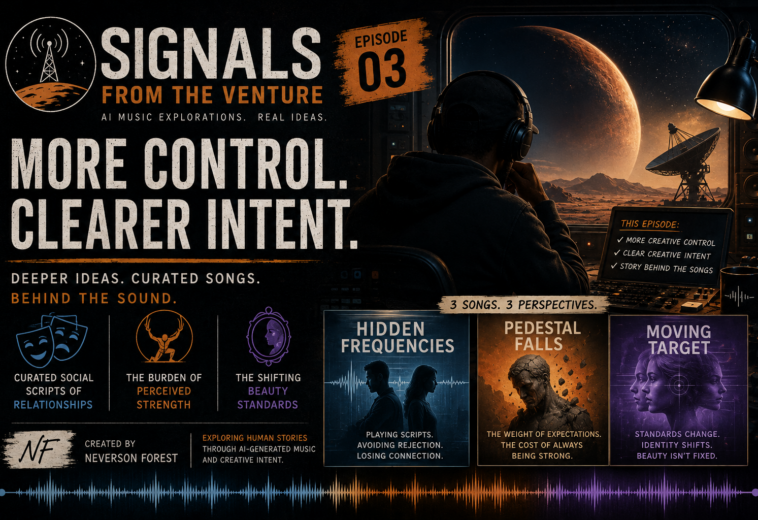
Hello. Today’s date is August 15, 2026. I’m happy to be publishing the next set of songs using Sunno. For today’s episode, I’ll like to provide a quick evaluation on the previous episode, focusing on things like what worked and what can be improved upon. By doing this, it will better explain the newest changes that I’m adding to today’s episode. To begin with the background music, I’m satisfied with how well it flows with the voice over and the tone of the show. While I’m not fully set on making a permanent part of the show, I do think that it adds something valuable to the overall presentation. Now, with regards to the number of songs and key messages, I’m happy to stay at three songs per episode, as it allows enough room to sit and enjoy and to think deeply without changing focus too many times. Plus, one of my writing goals for all my project is to keep it short and simple. And with that being said, I’ll be simplifying the key messages behind the songs, which will give more room for the newest part of the show. This new part is about connecting all three songs into a single narrative, like a story with a beginning, a middle, and an end, but with songs in this case. This means that every episode will focus on one single theme. Theme. Wow.
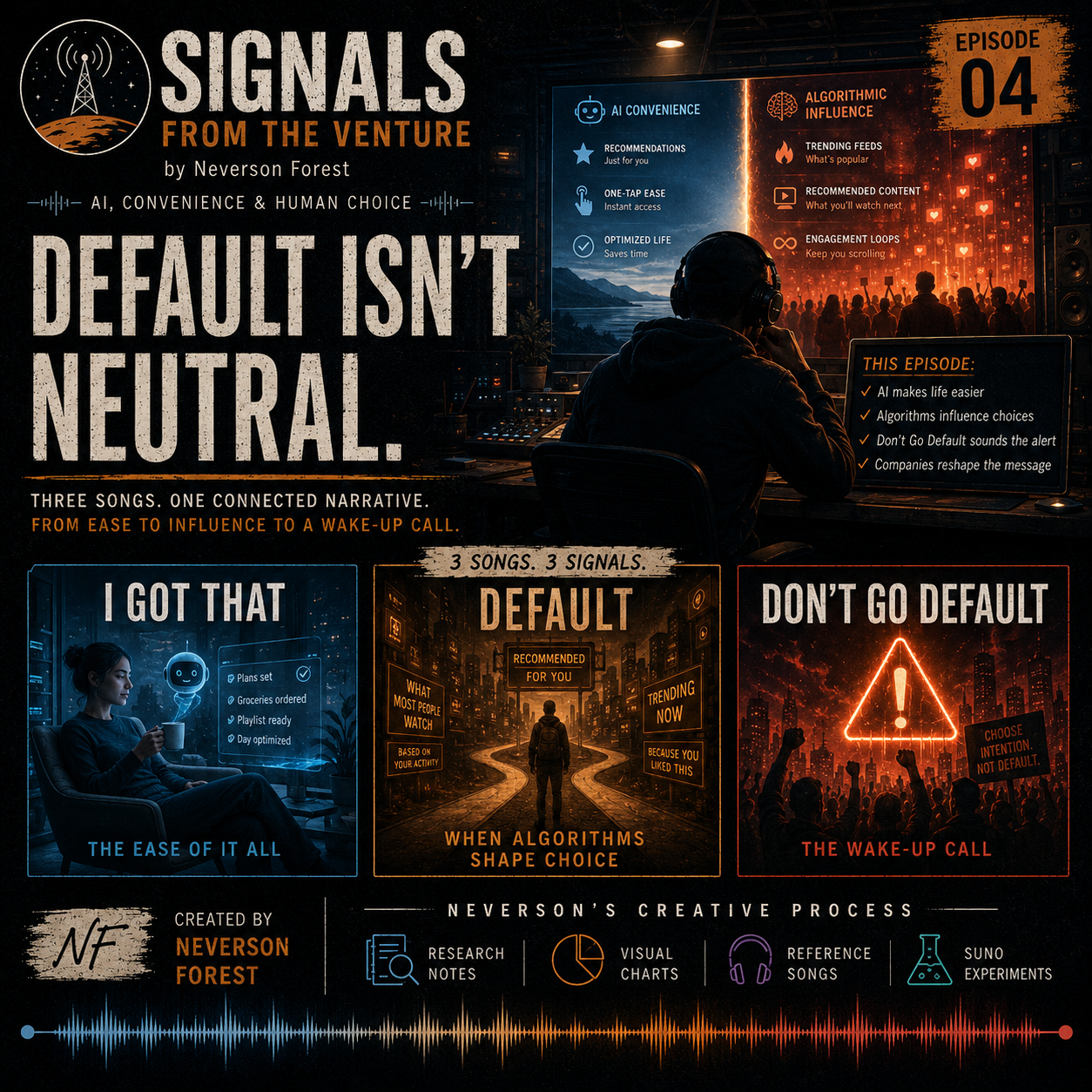
Current beats. Now, for the current beats section, I wanted to make it more transparent about the entire creation process, or more accurately, generation of these AI songs. This means providing a detailed summary of what I did to generate it and the reason behind my decisions. For today’s episode, I approached it with the goal of creating songs about the increased reliance on AI systems and algorithms, friendship, and graduation. I selected these songs using an Excel visual chart that connects themes, key messages, song styles, instrumentals, and many more helpful information to create unique songs. As previously mentioned, this visual chart was created using a library of research songs, which consists of main lyrical themes, narrative, perspective, and tone, musical composition, structure, key ideas, and broad meanings. Once I selected the themes for today’s episode, I did further research and then and drafted the lyrics for the song default with the help of AI. Upon generating the first couple of versions of the song, I was not satisfied with the results. So, I then decided to listen to a bunch of songs within Suno for reference and inspiration. Shortly after, I built a playlist of reference songs and started experimenting with different song styles that connected with the lyrics I had drafted. Through slight changes in lyrics, vocal performance, and style influence, I was able to generate the songs that met my expectation as well as deciding to solely focus on one single narrative.
Okay, that’s my indication to introduce the first song. It is called I got that. This song is about an upbeat AI assistant that handles everyday tasks like removing tedious work from people’s life. And the overall message is about embracing AI as a tool for reducing unnecessary work so people can focus their time and energy on things that matter the most. I decided to open with this song because I wanted to showcase something that is familiar and can be current and can be currently seen through commercials and advertisement of AI models and agents. The song style has an energetic, playful, catchy rap with Latin influence. This style is very different than what I originally had planned. The original was supposed to be slow, sensual funk, but the results were far off my expectations, so I decided to go with something more energetic and catchy. And that’s all for the introduction. Enjoy it.
Song #1: I Got that
I got that. Man, that’s catchy. I can legitimately say that I have a few things that I regularly rely on AI tools, especially now with the increasing number of projects to enhance and maintain consistency. I am aware of the growing dependency and have developed methods to balance the usage of these AI tools, but I do know for a fact that consistently relying on it is weakening my creative abilities. And this is where the next song comes in. Based on the fact that we as humans prefer the path of least resistance because it is very taxing on the brain for the amount energy it takes to process information, make decisions, and solve problems. It would make sense that we would adopt these AI models and agents to make it easier to process less. However, history has shown us that we as humans also like to be in control, especially when it comes to decision that directly affects our lives. This next song is called Default. It acts as an alert or warning, but it is disguised as a club dance track mixing disco and funk for wider audience. The song warns about how AI algorithms or just algorithms in general and convenience can gradually influence what we watch, what we think, what we want, and what we believe. The song encourages listeners to resist passive consumption, question automated suggestions, and protect curiosity, individuality, and the ability to make your own choices. Yeah, the actual song style is indie rock, postpunk dance, synth rock and new wave. I knew exactly what I wanted when I was drafting the lyrics, especially the title. So, I never deviated from the actual song style while experimenting. I just made slight changes in vocal performance. And that’s about it for the introduction. Enjoy.
Song #2: Default
Default. Default. Default. And this is why I don’t sing or rap. Anyways, this is definitely an anthem song that people would use to fight off against something that is threatening their control or lack of it would definitely resonate with a large number of people because the concerns are truly legitimate and there’s already a growing dislike for AI models because it’s taking away people’s jobs, replacing human art with AI generated content and just the overall fear of an unknown powerful technology. Unfortunately, history has shown us that resisting change has never stopped change from happening. And these AI models and agents do do truly help to make people’s life easier and support progress in fields such as medicine, energy, agriculture, and many more. Because companies typically strive to acquire a large user base, they would slightly adapt and embrace some of the views of the majority while diluting the more controversial aspects of the technology to make it more acceptable to a wider audience.
And this is where the last song comes in. It basically copies the lyrics of the previous song, but it slightly adjusts them to remove the controversial parts of the original message. For example, the core structure and the overall idea remain recognizable, but the language is softened to make the song less controversial and more broadly acceptable. So, in this case, the song will be written by an AI model and a widely beloved artist will perform as their own without disclosing the true writer and producer. Now, with regards to the song style, it is a laid-back blend of bedroom pop, glitch pop, and lo-fi disco. The style feels dreamy, playful, and slightly nostalgic. And that’s all for the introduction. Enjoy.
Song #3: Don’t go default
And there you have it. Another infectious, catchy song that is very softened where listeners can easily forget the true original message of the song. Anyways, that’s all I wanted to say for this song and a narrative built for today’s episode. Overall, I thought this episode served as an interesting experiment, not only because of the three generated songs, but how they connected together to tell one larger story.
I’m happy with this approach, as it gives me more creative ideas to explore unique songs while keeping the episode focused. And to address the elephant in the room, I found it ironic and funny to make songs about the dangers of consistently rely on AI models and agents while using the very same tools or models to assist with the lyrics and generation of the songs. Anyways, I can’t wait for the next episode to take what I’ve learned and explore further. Thank you for listening and until next time, take care.