- June 9, 2026
- 13 views
Okay, I think we’re good to start today’s episode. Now, to start off with today’s date, it is June 8th, 2026, and it’s been a while since the last episode, which occur back on April 6th of 2026. And as a result, I have a lot of updates to cover. So sit back and relax because this will take a while. Okay, so the first project update I would like to cover is the newest platform that I’ve joined. It is called Frame rate.tv. It is a video sharing platform primarily focused on creators, filmmakers, animators, and artists looking to showcase their creative projects. Having done my research on this platform, I found that it meets my needs when when it comes to visibility, customization, and analytics.
Because the platform is fairly new with a small user base, it is primarily focused on artists like myself with my type of projects. So, I believe it should increase my project’s visibility. With regards to customization and analytics, I like the presentation option it offers, especially with its embedded abilities that I’ve been looking to add to my website. And for the analytics, it’s just about having another platform compared to compare it to my YouTube channel as it will provide some good insight through comparison which will create a bigger picture of audience engagement as well as identify areas to improve on for better reach. Now all of these benefits do come with a cost. I paid for the full year to fully experiment this new platform and confirm my assumptions. Another platform that I joined for a year is but I did it long before frameway.tv.
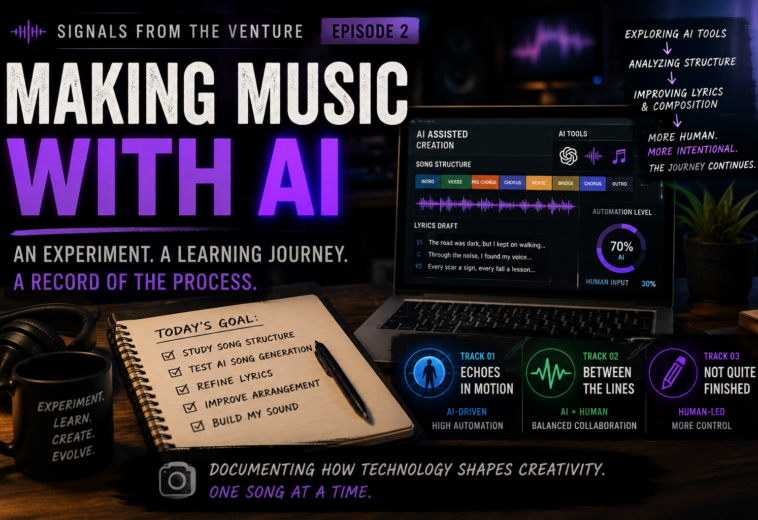
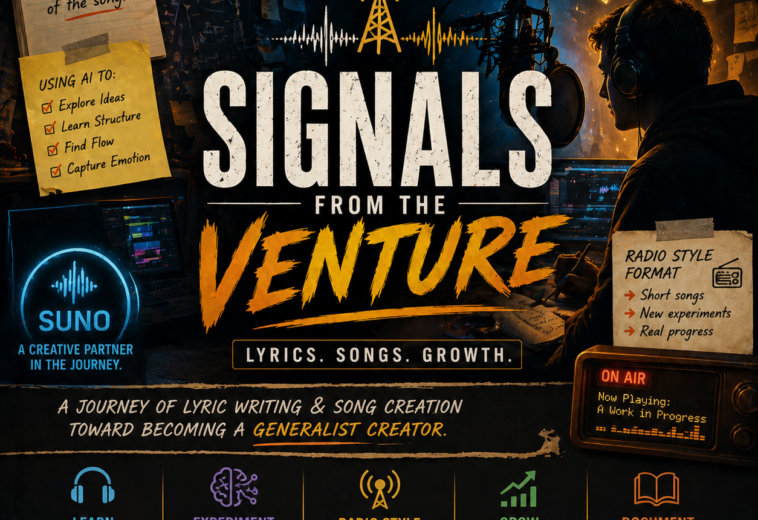
I initially created a free account to test out AI generated songs to determine whether or not I could add it to my workflow. But after some time of experimenting with different prompts and music style, I discovered that I wasn’t at the level that I needed for my project, but it could be used in specific circumstances like using it as a tool to write lyrics and compose beats. And this particular idea gave birth to the audio series that I went on to create, Signals from the Adventure. This audio series is an experimental playground to generate songs and study songwriting structure, pacing, vocal delivery, and overall music composition. And this perfectly flows on to the next update, which are the latest addition to my audio channel, Seven Wonders Ventures. As mentioned in a previous episode, I had committed to creating an audio channel that would include a list of audio shows designed to enhance my audio design skills and other things.
As of today, the audio channel has been created and it is available in Spotify and Apple podcast and includes a total of six audio shows and with a total of 16 episodes combined. This audio show that you’re listening to is part of the six shows. It includes the calligraphers archive, questions and confessions and the latest additions are Flames of Influence, Backstage Lens, and Signals from the Venture. All of these shows offer a unique audio experience with different formats and topics as well as setting the foundation for the video episodes. The next set of updates are short and minimal because of the amount of progress and effort has been put towards them. Since the last episode, I’ve done some research and tests into mixed reality, and it led me to create a new video series center around physical fitness in a very creative way. The name of this new video series is called Leveling Within.
Another new video series that was created in the process of developing the artwork teardrops is call mirror trial. This new video series is center around hypocrisy and it it is illustrated through a trial with interesting characters. The last new video series is called conduit sparks which is focused on inspiring artists to start and continue their journey through short videos like commercials. And with the creation of these series, I’ve started to develop the logos to make them officially part of the channel. So stay tuned as I’ll be providing more details on each of these series in future episodes. Now, excuse me. For the last project update, I’m happy to have completed and published an artwork called Teardrops. I am very satisfied with the level of problem solving and critical thinking that was used to complete this artwork. I’ve learned a lot and developed some new techniques that you will see across different projects.
And with the completion of this project, it means that I’ll be resuming work on the teaser video for the upcoming short film, Disconnect. Part one, the script and the voice over are complete, and the final piece is the video. Given the length of the voice over and the script’s new direction, it will likely be a motivational video with some subtle hints for the upcoming short film. And now moving on to the episode recap. In the last episode, I provided a strategic guide on managing multiple creative interests while also highlighting the advantages and disadvantages that come with it. I reflected in my own experience of learning to the line my attention across different creative disciplines without losing focus or burning out.
In this same process, I discovered that my skill set overlapped in different creative disciplines and that it could be used as a springboard into new creative disciplines and it could also be combined to create a generalist skill set and unique creative projects. And based on the conclusion of the last episode, my initial intentions were to focus on the topic of managing healthy levels of comparison. Unfortunately, A number of things happened that caused me to pivot and focus on a topic that is more current and personal to me. As per the number of project updates highlighted earlier, I have done a lot of work and completely drain both my mental and physical energy as a result of completing three audio episodes in a single day. I did not anticipate the high workload given the fact that all the scripts were already written. That being said, I did take 2 days off before fully resuming work on personal projects. But when I returned, my creativity was no to be found.
And while my physical energy had returned, I had no motivation to do anything artrelated. So, this became the trigger to take 2 weeks off to fully rest, recover, and relax. Like a dream, my body and mind were able to fully rest and process everything into neat little boxes. Upon reflection, I realized that I had overworked myself and there was an information overload, which prevented me from processing new and existing information. As a result, I had decided to only focus on the teardrops project and change the topic of this episode which is now the experience of working alone as a creative artist. I find that by providing my experience of working alone, it will provide help to those interested taking a similar path. The structure of this episode will go something like this. First, I will briefly explain my overall goal for all of my work and then I will go into describing what I typically do on a full day dedicated to personal projects.
After that, I will provide a list of ways to deal with challenges and problem solve. Now, if you’ve been keeping up with all the projects that I published thus far, then you’re aware that my overall goal is to become a storyteller. But not just any storyteller. I’m striving to become a generalist who can create across multiple creative fields where audio, visuals, and writing all work together to support a single idea. In order for me to achieve this ambitious goal, I have separated it into manageable blocks or more like steps to effectively build towards it. I’m currently in step one where it involves building a foundation for establishing the platform, developing an effective workflow and gathering the necessary equipment. Additionally, it includes building a strong foundation in each creative field while also finding a cost-effective approach and developing a schedule that is both manageable and sustainable over time.
Now, I officially started step one back in 2021 and I will soon be moving on to step two. And I say this to say that there’s no telling how long it takes to move from one step to another. So my situation is very different. So it should be taken into consideration if you wish to take a similar path. For example, I’ve been able to keep working on this goal because I’m self motivated. I strive towards meaningful progress over performance. I also have some disposable income that allows me to finance these projects and more importantly, I have the necessary time to work on them. Finally, I’m also very patient and have a strong background in video editing, which has proven to be one of my most valuable skills. Because I value progress over performance, I committed to make this goal into a journey where everything is documented. This is because I understand that the reward is in the journey and I won’t ever experience or feel this again.
So, I would like to document everything to eventually look back and see how I reach this goal. And at the same time, I would like to provide a road map for anyone looking to take a similar path. Now, focusing on what I typically do on a full day dedicated to personal projects. I promise to be concise and not overly detailed because if not, it could take hours to get through everything. Now, to start off the day, I normally start out with a 6k walk in the morning as this gives me the opportunity to both take care of my fitness needs and plan out the day with the list of tasks. I organized by the length of time to completion, importance and difficulty. I normally look to complete the easiest and least time-consuming tasks first. And this strategy works well for me because I work on multiple task which means I frequently switch from one task to another whenever time calls for it.
This is because each task offers a unique set of challenges and I have learned not to force things whenever problem solving is not working, but instead take a break or move on to something else. I also have come to understand that regardless of of the amount of planning and research that is done. It is also very important to be flexible enough to adjust and pivot when necessary. Sometimes I could just end up working on one single task because it requires a lot of time and attention to detail. Now midway through the day I regularly take a 2 to three hour break. Excuse me. And in this break, it involves a 2k walk and a lunch to reflect on the earlier part of the day. This reflection period gives me the opportunity to step back and assess how things are going, how to deal with ongoing challenges and identify the primary task to focus on. Once the break concludes, I resume work by focusing on one single task and this is usually the most difficult and time-consuming task.
The plan is to make as much progress as possible so it becomes easier and less and less time-consuming on the next dedicated project day. And I guess this concludes a regular personal project day for me. Now, please be mindful of the fact that this is not my final approach for working on creative projects. Like with everything of my creative journey, it will continue to evolve through experience, experimentation, and reflection. A lot of the strategies that I use today are taken from things I frequently do and find it beneficial. For example, planning out the day comes from work. Taking a break from difficult challenges comes from video games. Focusing on one single thing comes from school. And there’s many more other examples, but I don’t want to take forever listing them out.
Now, for this last section where I will provide a list of ways to deal with challenges and problem solve, I would like to use the perspective of driving in a heavy traffic highway and completing a difficult video game. I often link challenges to a heavy traffic highway because it mirrors on the fact that the destination is clear, but the path is rarely ever a straight line. So, whenever you drive in the highway, you’ll likely encounter traffic, sudden lane changes, detours, and moments where you’re forced to slow down or completely change direction. In the same manner, creative projects offer the same challenges, just in a different format. When I first started my creative journey, all I wanted to do was to create a number of films, but I had to quickly readjust, slow down, and pivot given the number of challenges that I was facing.
The biggest lessons that I learned which has shifted my mindset has been to control what I can control and go on my own pace. These lessons have taught me to stay calm when facing difficult challenges and that not every challenge require forceful action. For example, sometimes the best decision is to stay in your lane, maintain steady progress, and wait for the situation to clear up instead of making impulsive decisions. Other times you’ll need to change lanes, slow down, or even take a completely different direction to continue moving forward. And with regards to difficult video games, I see similar patterns in how the difficulty encourages problem solving and critical thinking instead instead of relying on brute force to succeed. Difficult video games rewards you for patience, awareness, and adaptability. Over time, difficult video games have taught me to slow down, observe patterns, and understand systems before attempting to overcome them.
As a result, these games have significantly contributed to the development of my problem-solving abilities and more importantly taking time off to allow the mind to process the information in the background since some solutions only come with a clearer perspective. Now to bring everything together and close this episode, the main focus of this episode was not just about my experience of working alone as a creative artist, but more on stressing the importance of taking time away to rest, to recover, and finding other angles to overcome challenges. Without doing so, I would have continued pursuing this goal of mine in a way that led to repeated cycles of burnout, reduced motivation, and diminishing returns. Working alone means you become responsible for everything. You’re not only the creator, but you’re also the planner, the writer, the video editor, the photo editor, the audio editor, motion graphic designer, and so much more.
Unfortunately, there’s no predefined structure or guide that explains how to build an effective or a sustainable system. Much of the process comes through experience, experimentation, and self-reflection. Thankfully, over time, I have developed a better understanding of when to push forward, when to pause, and when to completely take a step back. I have learned that reflection and rest and even moments of frustrations are all valuable parts of the creative process. They provide a space for ideas to settle, information to be processed, and solution to emerge without unnecessary pressure. So, my goal in sharing all of this is not to present the perfect system or a final answer because I don’t believe it exists. This episode serves to document what I’m learning as I go with the hopes that it will it provides some value to those on a similar path or considering one. And I guess this concludes this episode. So until next time, take care.