- March 9, 2026
- 5 views
All right, I believe we’re good to start. So today’s date is March 8, 2026. And where do I start? I’m asking myself this question because I I have a lot of things on the go and these are all small pieces that will eventually merge together to complete several projects. These projects will help to build the bridge to export my first ever short film. And uh in case you’re wondering, this is the project update sections where I get you caught up with all project related updates. First, I would like to happily announce that I’ve created a new series or audio series that features three hosts speaking three different languages and summarizing key topics. This series is designed to help me write dialogues for characters and work with uh with uh voice changers. Um I would also like to highlight that this series will eventually have video episodes too. This is to stay consistent with my updated workflow to first build the audio and then use it as the base for the video. And as previously mentioned on the last episode, I started to work on a behind-the-scenes project for episode one of the gravitational idea series. I’ve made some progress on it. For example, I’ve gathered all the images, handwritten notes, videos, and I’m now starting to develop concepts with the interface. I intend to showcase a bunch of images, videos with the voice over walk through. The project is moving as expected, but I don’t have an estimated completion date.
Now, moving on to journal updates. I’m excited to share that I’ve built the full the full audio network I mentioned on the last episode. This specific show is now one of three shows under my account on both Spotify and Apple podcasts. I am currently in the process of releasing the first episode of the Calligrapher’s Archived. This is the new audio series that I mentioned earlier that features three hosts speaking three different languages. I am eager to expand my skill set and use the lessons learned on this show to show to explore new formats and showcase uh unique perspectives.
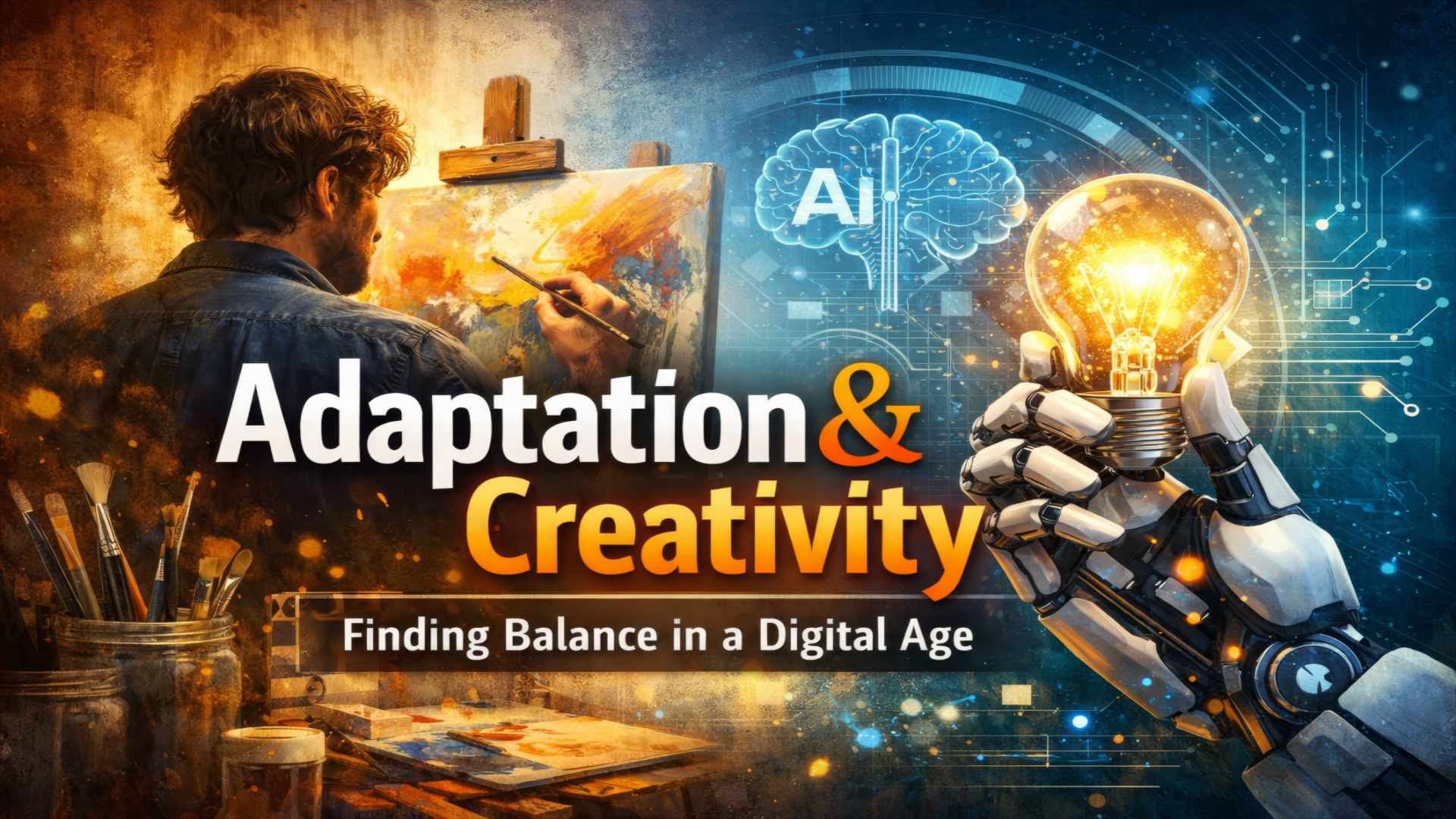
Now with regards to today’s episode. I want to provide a short recap over what happened in the last episode. We talked about the dilemma of AI art, specifically on how it can accelerate production, but if left unchecked and unbalanced, it can flatten personal artistic growth. Today, I would like to focus on the theme of adapting to the current landscape as AI art is beginning to disrupt and challenge humanmade art. Rather than simply providing recommendations, comes to adaptation. I’ve also decided to provide recommendations for creativity because it is an essential element in how artists respond to change.
Now before we go any further, I would like to define adaptation creativity as well as highlight my biases with AI tools. For adaptation, I believe that it refers to people’s ability to adjust their approach, their mindset, values, and many other things in response to changing conditions. To put it simply, it’s about adjusting to change without losing your sense of direction and core values. Now, when it comes to creativity, it’s about people’s ability to explore, connect, and refine ideas to create something new. It’s basically learning from different sources and blending those ideas into something new. Now, with regards to my biases with AI tools, as previously mentioned, I view AI as a powerful tool that is neither good or bad, but it’s a reflection of its user. At the same time, I’m cautious about AI tools as they can easily remove essential experiences that help artists develop their skills, their judgment, and creative instincts.
So, the challenge artists face today is not whether AI should exist in creative spaces since resistant change has never stopped change from happening. The real question is how artists can adapt to to a changing landscape while still maintaining their core principles, creative directions and creativity. Now, I started doing creative work as early as 2015 with video editing and then gradually expanded to motion graphics and 3D. The more complex the projects became, the more I require advanced software to meet my needs. And these software significantly sped up production uh and timelines and remove a lot of tedious work. And most importantly, it introduced me into a whole new range of ideas and skills that led me to create this or led me to start this creative journey. This is all to say that I’ I’ve always been adapting and building my creativity along the way. Each new tool did not replace me. It just expanded the ways that I could explore my creativity. For example, the software only really became effective when I spend a lot of time learning how they work, understanding their limitations, and developing a creative workaround to meet my needs. In this sense, the tools have never been the the the key. Let me repeat this. The tools have never been the the the key source of my work, but merely instruments that allow my creativity to take form.
And uh with that being said, here are some of the lessons that I’ve learned through my years of adapting through change in the creative landscape. I would start by recommending to develop and commit to core principles that won’t change. This is basically just setting standards and boundaries of your work. While tools, trends, and technology change around you, having a strong foundation allows you to make decisions that are consistent with your vision rather than reacting to external pressures.
The next lesson is about strengthening your fundamentals. This is meant to build on your core artistic skills that remain valuable regardless of the tools that you use. This can include skills like storytelling, composition, color theory, design, design principles, critical thinking, and problem solving.
The next one up is to study a wide range of disciplines. So, this basically means exposing yourself to different mediums like music, uh, literature, film, design, science, uh, all things that expands the pool of ideas and perspectives to draw in in your own work. I mean to draw from draw from in your own work, if that makes any sense. So each discipline has its own way of thinking and has its own way of thinking, problem solving and expressing ideas. Learning from them can spark fresh creative ideas that you’ll never encounter if you stick to a single medium.
Now the second last one is about embracing experimentation. And experimentation is really where true growth happens. This is where you test ideas, you push boundaries and discover happy accidents. This is about giving yourself permission to try, fail, and learn without the pressure of producing quality work. It encourages curiosity and flexibility, which helps to develop a deeper understanding of your tools and your own creative process.
Now, the final lesson here is to view challenges as opportunities for growth. Every challenge, every limitation or change in technology is a chance to refine your approach, discover new methods, or improve your creative resilience. Each mistake ache or difficulty provides valuable insights into what works, what doesn’t, and answers as to why. Over time, these experiences increase your resilience and understanding, which deepens your ability to navigate through uncertainty.
Now, I believe that covers everything that I wanted to say about adaptation. So, now I want to move on to creativity as they’re close as they’re closely tied together. And as mentioned earlier, I view creativity as the ability to explore connect and refine ideas to uh to create something new. This ability is inherent to everyone as our bodies are like recording tools. Our eyes or ears or senses continually absorb information. Everything we take in becomes raw information for future creative work. So every time we face a challenge, we learn a new skill or explore a new tool where we’re engaging in creative acts. Apparently though there are some similarities with how AI system systems and the human mind processes information to create new things. For example, they both start by gathering information, identifying patterns and structures and then using them to create something new. Beyond this similarity though, their differences lie in source and intent. Human creativity comes with lived experiences, emotions, beliefs or an inner compass to guide meaning. Whereas AI system use massive data sets from humans to generate new things based on predictive algorithms. In short, human creativity tends to be deeply personal, reflecting on struggle, environment, culture, and traumatic moments that shape how we view the world or how we see the world.
Understanding the differences is very important for new artists who are still developing their creative foundation. So, if creativity grows from lived experiences, interpretation, then the first step in developing it is the consumption of information. This means experiencing and observing the world through things like reading books, watching movies, listening to music, reviewing artwork, and just everyday life. All of this information will slowly build a library of references that can later be drawn from when creating something new. Also, be mindful of the fact that nothing is completely original. As you begin to develop your creativity, your work may look very similar or even identical to the sources that inspire you. This is a natural part of the learning process. It takes time to build your own creative voice. Your influences will gradually blend together with your personal perspective and experiences eventually forming into something that is unique to you. In other words, it will have your own signature style.
And now for those who are looking to accelerate this process, I would recommend studying a number of artists from different disciplines. Artists like filmmakers, painters, musicians, writers, designers, and many more other or many others like like adaptation. Each discipline approaches creativity differently. By studying their work, you’ll begin to identify patterns in how ideas are structured, how emotions are communicated, and how certain techniques are used to achieve certain results. And uh I believe that’s it for today.
And um should be good to close uh or to sum up this episode. So the landscape of art will continue to evolve just as it always has. New AI tools will continue to emerge and challenge existing tools and artists will be asked to adjust how they create. Behind all of these changes though, the core process of creativity will remain the same. It grows through experience, observation, experimentation and refinement. The struggles, the lessons, the influences and personal perspectives is what gives meaning to artists to uh tools may shape the workflow but they do not define the artist.
So, if you’re just starting out or continuing to develop in your craft, remember to stay curious, keep learning from the world around you, and give yourself the time needed to develop your own voice. Because at the end of the day, creativity is not just about what we create. It’s also about how we grow through the process of creating. Until next time, take care.