- October 26, 2026
- 1 views
Hi there. Today’s date is October 26, 2026. I’m happy to have published this episode as it sets a new record for the number of episodes published in a single year, which is now seven. Yay. To avoid making this into a repetitive part of every episode, I will only highlight the final record number sometime in December or the beginning of January of 2027. So, stay tuned for that. With the first full year of podcasting coming to an end, I have collected enough information to estimate a recurring schedule for this show which will be monthly, with about 8 to 10 episodes per year. Now, this is only an estimation, so it is subject to change. This is because the estimation is based on the total number of episodes published this year, overall project objectives, which include all the disciplines like video, art, and audio projects, and most importantly, my availability. While the project objectives may slightly change, I have full control over them and can adjust them when necessary.
Unfortunately, I can’t say the same for my schedule, which can be unpredictable just given the fact that I’m also balancing it with work, family, friends, and other miscellaneous things. And I say all of this to say that this is the most reliable estimate I can provide for now, but it will get better with time, I guess. Now, before moving on to the project update section, I would like to highlight that I’m just coming out of a two-week vacation where the focus was on getting some rest and a break from my usual responsibilities and creative projects. It’s been nice to step away for a bit, slow things down, and give myself some time to recharge. As a result of this break, I’ve been able to see the bigger picture of my journey so far.
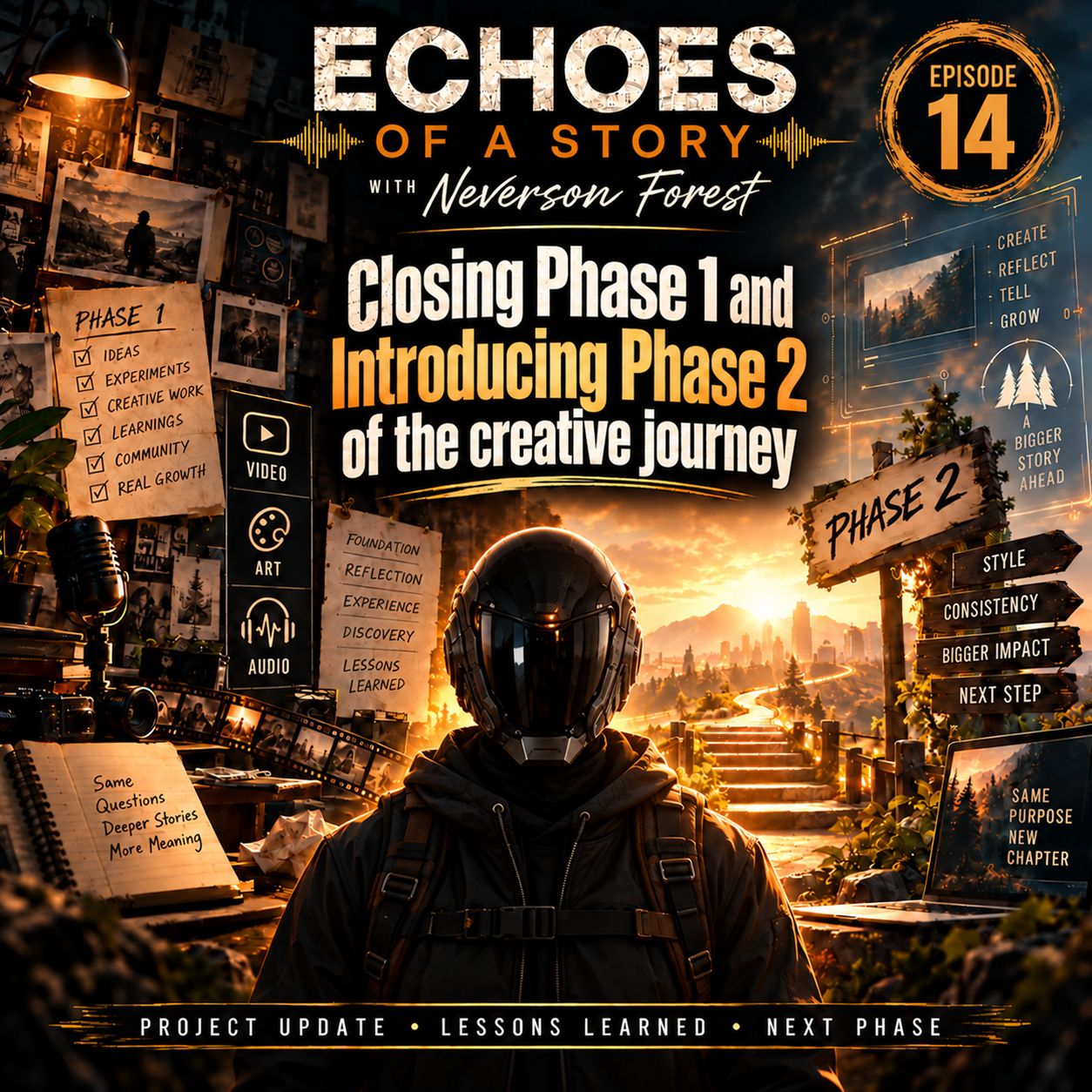
For example, I can see where the projects currently stand, curate which projects to complete before year-end, address ongoing creative challenges, figure out how much time I can realistically dedicate to each type of project, and decide whether it’s time to close out phase one and introduce phase two of my creative journey. The last point here is very important because it is the focus of today’s episode. I’ve been meaning to share details about the next phase of my creative journey, but before I dive into the details, I would first like to go through the project updates because there’s a lot of updates to cover. To begin with, an important update that I shared during the last episode of the Questions and Confessions show: I’m officially wrapping up the year with a few selected projects which will narrow my energy and focus on two video projects and two to three more podcast episodes for this show only.
This means that from here until January 2027, all other podcast shows and artworks are officially on pause. This strategy is nothing new as I often use it when I need to focus on a specific discipline and build a solid foundation. These podcast episodes are great examples of this, as they were the main focus for this year, while video and art projects received little to no attention or work. Currently, I have met my objectives of building a solid foundation across the three disciplines that my projects are centered around, which again are video, visual art, and audio. So, it is now time to wrap up the remaining projects for the year and begin preparing for the next phase of my creative journey. As for the two remaining video projects, the one currently being worked on is the teaser video for the short film Disconnected Part One. The title of the video project is called Igniting the Creative Spark.
This video project was originally expected to be completed by the end of July. Since it has fallen behind schedule, it will cut into the time to complete the second video project, which is the short film Disconnected Part One. While the short film is already 80% complete and just needs some quality assurance, past video projects have shown that I spend more time on video projects than I typically estimate. So, this is all to say that the short film will likely be pushed later into next year, hopefully mid to late January, so I can start introducing aspects of phase 2 and resume work on all other creative projects. Now, moving on to smaller project updates that currently do not impact things, but will play a bigger role as I move forward. To begin with, there’s the background music for podcast episodes. I’m currently running low on songs to choose from. This is due to the fact that I don’t repeat songs unless they’re essentially tied to the show.
Examples can be found in shows like Signals from Adventures and Questions and Confessions. The rest of the podcast shows have new songs for every episode. Now, I was lucky to have found an amazing bundle of loopable songs from Humble Bundle, which has fit perfectly with all the episodes during this early phase. I really enjoy the songs that I’ve been using as they’ve become part of the podcast development process. Unfortunately, I’ll need to start exploring new loopable songs or develop a more efficient way to create them myself. Although I’m familiar with the process, my current approach is too time-consuming and many of the songs don’t loop seamlessly. I view this issue as a blessing in disguise, as it encourages me not to remain stagnant this early on, but to continue exploring new songs and expand my creative influences. So, stay tuned for some new, interesting background songs in the near future. The final project update is a series of many updates that I drafted during my vacation.
My vacation started on September 22nd and lasted until October 1st. During this time, I stepped away from all creative projects and instead focused on reflecting on completed, ongoing, and future projects. Future projects were the main focus of my reflection, so I could accurately plan for phase 2 based on all the lessons learned. For example, I brainstormed topics across all the podcast shows to reduce planning and development time. I also reviewed the list of available assets and my current workflow to better optimize for efficiency, and I curated a list of assets that fit within my developing visual and audio language. Now, by visual and audio language, I’m referring to my signature style for all of my creative projects. This can include things like the color palette, typography, song cues, and the way I arrange things with repeated visual and audio themes.
Like with most things, I accidentally started building this language when I started my journey. Now I want to start taking control to achieve consistency and narrow down the scope. Now, to recap the previous episode, I approached it from an observational perspective based on recurring patterns that I consistently found across the three disciplines that I’ve been exploring. This discovery also took me back to unanswered questions from my childhood. To accurately summarize the patterns in a simplified way, I explained it through the nine stages of the idea cycle, breaking down a lot of information into simpler concepts that everyone can understand and recognize in real life. The cycle explores how ideas emerge, grow in popularity, become mainstream, and eventually inspire countermovements as people begin searching for something different.
The goal is to make it easier to spot the patterns as they happen and to use that understanding to make more intentional decisions both as a creator and as a consumer. While I would like to continue exploring other observations, I’ll save that for another time and focus on something much more important and time-sensitive, which is today’s topic. To begin today’s topic, I would first like to congratulate myself for reaching the final stages of phase 1 as this is one of the biggest accomplishments in my creative journey so far. Looking back, phase 1 officially started on September 11, 2021, and it’s been approximately 5 years since then. During this time, I’ve built a solid foundation across the three disciplines I decided to explore which again are video, art, and audio. I’ve also built a central website to showcase my projects and document their development, including the ideas, the tools, and the creative decisions behind them.
As I’m officially transitioning to phase two, I have decided that now is a good time to reflect on the objectives I set for phase 1, what I’ve accomplished, and what I’ll carry forward as I step into phase two. The objectives I set for phase one originally consisted of several ideas I wanted to accomplish in my first year. My main goal was to introduce my channel, give people an idea of the types of projects I would publish, and share what I wanted to accomplish for my overall goal. I initially started by publishing previous practice work to develop my skills. I wanted to give people an idea of the types of projects that would follow and show the progression of my skills, and eventually publish a short film filled with action-packed scenes. Unfortunately, I quickly realized that my skills were not at the level that they needed to be to bring my vision to life.
As a result, I decided to put the short film aside and introduce a new objective, which was to develop my visual art skills and document the process. As I gained more experience in visual art, I became more ambitious and increasingly focused on improving the quality of each piece. I discovered better tools, identified areas for improvement, and came up with new ideas to explore. While that helped me develop my visual art skills, it also led me to spend more time on refining each piece. Eventually, this habit carried over to video projects as well, slowing down my progress across other areas. To address this issue, I put the video project aside once again and introduced another new objective, which was building my own website as the central hub for all of my projects. Now, the idea behind the website was to share more details about each project, things like the software, the assets, the influences, the motivations, and the decisions behind them.
However, when I returned to working on video and art projects again, I came to the realization that I was spending so much time refining them that it became too difficult to complete them consistently. This became especially clear with the gravitational idea project, which took me 3 years to complete. In an attempt to correct this, I introduced another new objective, which was to explore audio design through podcasting. I wanted to shift my focus towards smaller projects that can be completed more consistently, which would lead to creating more projects and improving my skills as a result. Through this process, I realized that there was no need to rush given the range of my interests and the potential for continual growth. I decided to work at my own pace rather than force myself to meet unrealistic expectations. I also began to see the value of developing my skills across multiple disciplines and bringing them together to support a single creative vision.
This realization also helped me to shape the direction of phase 1. Rather than focusing solely on individual projects, I decided to build a solid foundation across the disciplines I wanted to explore. And at this point, the overall goal for phase one became about completing 20 projects in each of the areas to set a foundation so that I would be confident in my abilities and have a clear sense of direction for the next steps. So, all in all, I discovered that I wanted to build something sustainable that can support my future projects and help guide them in the right direction. To conclude this section, here are some key takeaways for new artists. Your original vision won’t always match reality, and that’s not a failure, but it’s an opportunity to learn. You will face unexpected challenges. You’ll change directions, and you’ll often discover new interests or strengths along the way. Instead of treating changes as setbacks, think of them as part of the journey. They may even lead you towards a direction that better suits your interests and goals.
Now, moving on to phase two. I want to build on the foundation I’ve established over the past 5 years. With a better understanding of my interests, the skills I have developed, and the areas I want to refine, I now have a clear idea of how I want to approach the next stage of my creative journey. During phase one, I introduced several shows and series designed to help develop my skills across the different disciplines. Podcasting is a great example as I’ve experimented with different formats, structures, and messages to improve various aspects of my skills. I took a similar approach with video and art projects. Now, for phase two, it’ll be about putting the learning experiences into practice and creating work that builds on the skills and the knowledge I have gained. Another important part of phase two is developing my visual and audio language.
As I mentioned before, I want to develop a signature style that ties my work together across the three disciplines. This means that I will be more intentional about where and how I experiment going forward. The goal is to give people recognizable elements and repeated visual and audio themes instead of leading with a collection of unrelated assets. I also want to focus on publishing projects more consistently across the different disciplines with a stronger foundation in place and a better understanding of my creative process. I feel that I’m in a great position to build on what I’ve already established and bring more ideas to life more consistently. To be clear, I’m not making any promises here, but I hope to publish more projects, especially in video and art, with a level of consistency closer to what I’ve achieved with podcasting. Alongside the projects, I also want to continue documenting my creative journey.
This means not only sharing the finished work, but also the process behind it, including how things are progressing, why I’m developing certain projects, and what influences the decisions I make along the way. I want people to be able to follow the progress, look back at the important moments, the ideas, and the decisions that help shape each project. In doing so, I hope to provide a clear picture of how my work develops over time. But documenting my journey isn’t just about sharing it with others. It’s also a way for me to hold myself accountable for the goals I set and the projects I commit to. By keeping track of my progress, I can look back at what I’ve accomplished, identify areas that need improvement, and make more informed decisions about what to do next. Since I’m working by myself, it is important to step back from time to time and evaluate how things are going.
If I’m constantly rushing from one project to the next, I may repeat the same mistakes and overlook opportunities to improve. So, to put it simply, phase 2 is about finding a better balance between creating, improving, and reflecting. I want to keep moving forward in a way that allows me to grow, complete projects more consistently, and build something sustainable over time. In this last section, I want to reflect on the key lessons learned through phase one and explain how I’ll measure my progress moving forward for phase two. So, looking back on phase one, one of the biggest lessons I have learned is that constantly chasing perfection can slow me down and make it harder to actually finish projects. Shifting towards smaller projects has helped me to keep moving forward, giving me more opportunities to practice, to experiment, and to learn without spending too much time on a single project.
Another important lesson was realizing that my interests naturally include multiple disciplines, which again are video, art, and audio. This lesson led me towards a more generalist approach instead of just focusing on the video discipline. I realized that bringing my creative ideas to life would require developing a wider range of skills beyond video editing alone. For example, video production can include things like 2D and 3D animation, live action, visual effects, and different editing techniques. Visual art introduces different styles, techniques, and approaches that can help shape the overall look and feel of a project. Audio goes beyond sound design; it includes character voices, dialogue, music, storytelling, and emotions through voice. For the achievement indicators, I want to focus on a few key indicators to measure my progress.
The first is whether I’m publishing work consistently across video, art, and audio while continuing to develop the series and the shows I have established. Another indicator is how my skills are developing across these disciplines, particularly how well they complement one another within an individual project. I want to see how the skills I’ve gained in one area support those in another and how combining them creates interesting and unique skills. I’ll also be looking at the development of my visual and audio language. This includes the use of recurring themes, consistent creative choices, and visual elements that make my work more recognizable. I want to see whether my projects are becoming more cohesive, and whether my overall creative direction is becoming clearer. Now, to conclude this section, documenting my journey will remain an important indicator of my progress.
I want to be able to look back on my work, recognize how my skills have improved, understand the decisions that shape my development and identify areas that still need attention. Together, these indicators will help to evaluate whether I’m making meaningful progress, staying consistent with my goals, and moving closer to the goals I set for phase two. Now, to conclude this episode, phase one has been a journey of exploration, learning, and growth. When I first started my journey, I didn’t expect it would take this long to reach phase two. Over the years, my interests have evolved, my skills have developed, and my plans have taken unexpected turns. Looking back, I’ve come to understand just how unpredictable the creative process can be. As I move into phase two, I will focus on bringing my skills together, developing a recognizable style, and bringing more ideas to life. I don’t know exactly how long this next phase will take, but I’m excited to see where it leads me.
No matter how much I prepare or plan, there will always be things that I cannot predict. And as a result, I’ve learned to accept this as part of the journey. What’s more important is that I will keep moving at my own pace, embracing my mistakes and learning from challenges, and figuring things out along the way. Thank you for listening. Until next time, take care.