- February 16, 2026
- 24 views
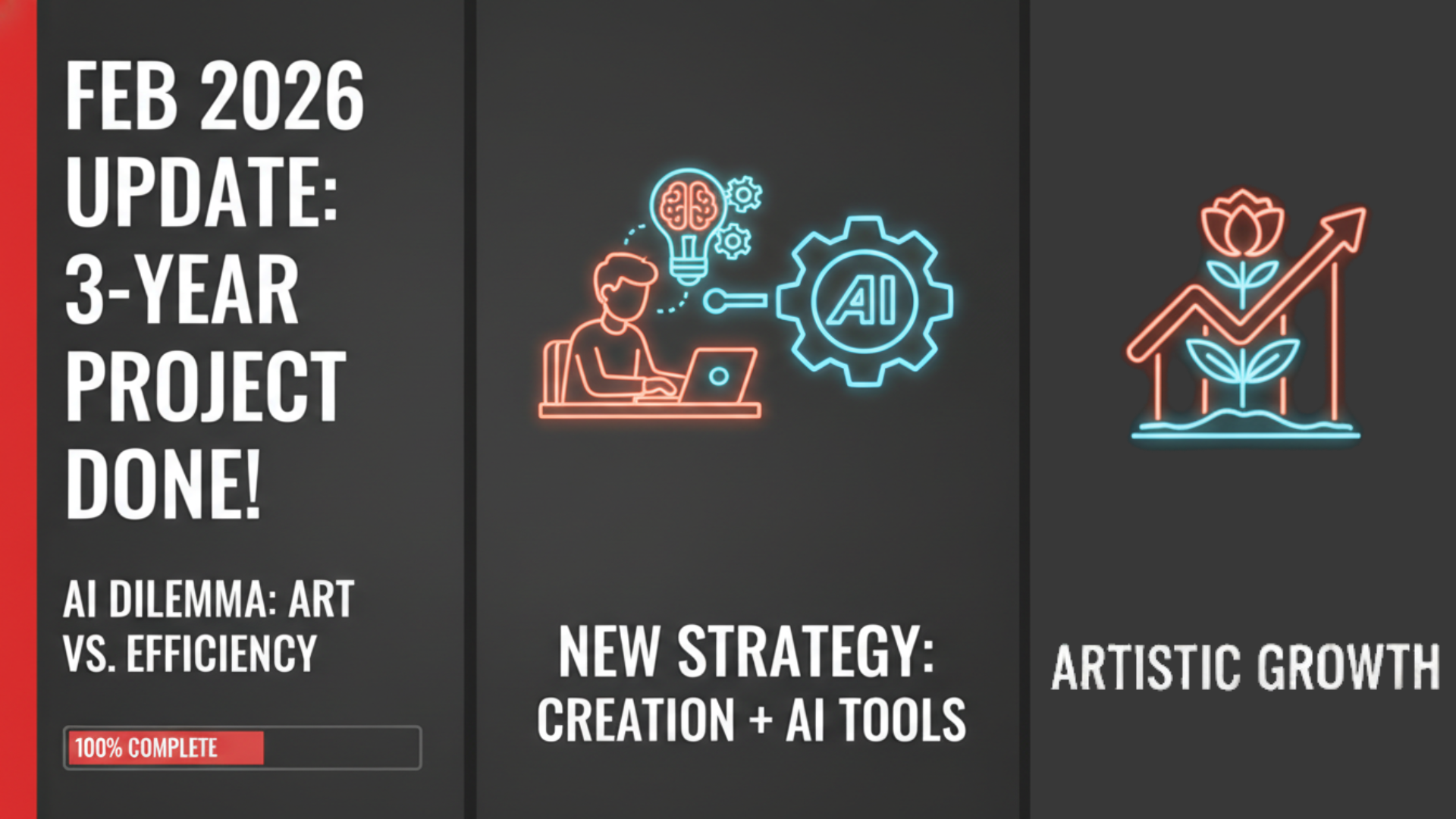
All right, I believe we’re good to start. Um, today’s date is February 15, 2026. And yes, you heard that correctly. It is February 15, 2026. Right after completing the previous episode back in December 21st of 2025, I decided to take a break for the holidays to spend time with my family and friends. And when I attempted to return, I got sick and needed about 2 weeks to fully recover. Upon my recovery, I decided to solely focus on completing episode one of the gravitational idea series. This means no hip hopping between projects, but just work on one. I guess this flows perfectly onto the next section of the episode when it comes to project updates. Um, I’m happy and excited to announce that I’ve completed episode one of the gravitational idea series. Yay. The project has been published on my YouTube channel, Patreon page, and most importantly on my website. The project marks a significant milestone in my journey simply for the fact that it took 3 years to complete.
Now, to be honest with you, it shouldn’t have taken this long to complete it. Uh if you listen to the previous episode, then you’ll have some ideas as to why it might have taken this long. And with that being said, I’ve learned some valuable lessons um with this project. Uh and as a result, I’ll be creating a behind-the-scenes project that will dive deep into the process, the challenges, and the lessons learned. I’ve already started working on this project, and it will be published on my RStation page. Another key takeaway from the completion of this project is that I will attempt to focus on more smaller projects and commit to building an audio network that will be the base from which videos will be created from. For example, I created this audio series where I’ll be reviewing influential movies and video games. The episodes will first be available uh through an audio version and then be turned into a video um later.
And this particular episode that you’re listening to will also be turned into a video at some point, so stay tuned for that. Um, my last set of updates is that I’ll be producing a teaser video for a short film that I plan to publish sometime this year. And luckily for me, it’s not as ambitious as the gravitational idea one. Since the short film is split into three parts, and the first part is about 80% complete, I believe, I just need to add the audio and run it through a quality assurance process. Completing it will be another significant milestone, which will trigger step two into my journey. Uh, I’ll provide more details about step two as we get closer to it. I guess this completes all my project updates for today. And uh, with regards to journal updates, I’ll keep it short and simple. Uh, I’ll be reversing one of my recent commitments that I made to do multiple takes instead of the regular one to two.
While I wanted to sound a bit more confident and make less mistakes, I believe that these mistakes are very important part of the process that need to be documented to show growth and progress. Additionally, I’ll also be committing to keeping the length of these episodes short. Now, I’m saying this being mindful of the fact that it’s very early to make such a commitment because the structure of the podcast has not fully taken shape yet, but I I will do my best to keep it short and concise for most of the episodes. Now, I believe that covers all the updates and we should be good to start today’s episode. I decided that this will be a great opportunity to share my thoughts on AI and how I’ve been using it for my project. This has been a topic that I’ve waiting to speak on, but I didn’t want to do it prematurely just because I needed the time to fully inspect, research, and apply it before sharing my thoughts.
And based on my usage so far, it’s been a very it’s been a very valuable tool that has significantly increased the speed to produce my project as well as enhancing the quality. Plus, I started to include more AI tools into my workflow. And as of recently, I included it in my plans for future u for future major projects, which will be essential to me. certain timelines. And given my increased usage and reliance on these AI tools, it has forced me to address the dilemma that I’m currently in. I call it the dilemma of true growth and production. Now, before I go any further, I want to state my biases about AI and my overall goals for my projects, which will provide some clarity and context behind my decision-m. Now, when it comes to my overall goals, I’ve mentioned this before, it’s about going into the storyteller that I envision. This means always taking meaningful steps towards growth by expanding my horizons with unique perspectives and a large skill set.
For AI, I don’t fully have a clear uh stance on it. It just like with most things, it’s a spectrum that I’m currently looking to see where I’ll be most comfortable given my goals, values, and belief. I view AI as a tool that assists artists in many different ways. But just with like any powerful tools, it can easily influence artists instead of the other way around. The key question for me isn’t whether AI is good or bad, but whether I’m using it correctly, so it assists and enhances my creativity rather than replacing it. So, I work a full-time 9 toive job in the weekdays, and outside of that, I have an ambitious list of major projects for the journey that I have embarked on. At the same time, I’m actively trying to expand my skill set through self-arning, which will significantly help in the long term.
But time and energy are limited, and as a result, there are a number of delays, pauses, and things like switching to other project until I have a acquire the skills or found a creative solution. Episode one of the gravitational idea series is a clear example of this issue. But thanks to the help of AI tools, I was able to speed it up to completion as well as set the foundation for all my project. Again, thanks to the AI thanks to the help of AI tools, I was finally able to move closer towards step two of my journey. Something that I had planned on my first year, but now it’s been 4 years in counting. I guess this is where the dilemma surfaces. While I want to remain the artist, from conception to completion. I also want to streamline. I want to stay consistent. I want to I want to make I want to stay uh efficient with my uh with my project. Unfortunately, these two don’t work well together simply because they have opposite goals and method. See, true growth is messy.
It comes with friction. It is slow. It’s painfully sometimes painfully slow. Uh it can be expensive, not just financially, but like emotionally and mentally. It demands introspection as it is shaped by lived experiences, personal struggle, curiosity, doubt, failure, and emotion. True growth asks you to sit with confusion until clarity is earned. It develops the muscle of creativity through resistance and perseverance. Whereas production aided with AI tools moves very differently. It removes much of the friction. It speeds up timelines. It reduces cost. It offers instant structure to suggestions, refinements, and solution. Where true growth says figure it out. Production says here’s a shortcut. So neither are good and bad. Neither are good or bad. They just produce different outcomes. The dilemma in this case is what is gain and what is lost depending on which path I lean onto heavily. For example, if I overrely on the shortcuts, I may gain the speed but lose substance.
I may gain consistency but lose originality. I may gain polished results but lose the resilience and the perseverance that comes from figuring things out. The project itself may look refined, but my creativity may remain stagnant and underdeveloped. On the other hand, if I reject efficiency entirely, I may gain substance, but lose momentum. I may grow internally but struggle to publish things out consistently. I may protect the core process but will limit the scale and sustainability of the output. With all the details of the dilemma clearly outlined, my solution to this dilemma is intentionally broad because it must be flexible enough to evolve with experience and application. It is clear to me that I need both true growth and production. But I don’t want to lose the benefits of each. So I designed a structure where neither cancels their core benefits. And this means setting boundaries. Because true growth must be protected at all cost.
I’ve decided to accept friction and all the struggles that comes with it. So everything from conception, core ideas, themes, emotional direction, and meaning must all come From me. For production, it will serve something like an assistant role where once the vision is clear, it will help to refine the structure, polish the themes, organize thoughts, and speed up technical processes. Its primary role is to support execution, not replace me. So to put it simply, I don’t want AI to think for me. I want it to work with me. With the solution in place, it will help to maintain a clear balance by protecting my true growth as an artist while leveraging the efficiencies of production with AI tools. I am fully aware that this balance will likely require continuous self assessment because the line between assistant and replacement is in. It can quietly change if I’m not paying attention. So to conclude today’s episode, I want to make it clear that I understand why people fear fear AI art.
It feels disruptive, unfamiliar, and powerful in ways that challenges the traditional sense of human art. But I also recognize that AI art will soon have its own medium just like photography. digital art and film did. And resisting change entirely has never stopped change from happening. AI is both a tool and a mirror which can extend capabilities, but it can also reflect habits, shortcuts, discipline, and tension back to its user. So, it’s more likely to amplify what is already there. Technology has always shifted the landscape of art. The artists who endure were not the ones who ignore change, but the ones who adapted without losing their core principles.
People have been making art since the beginning of time and will continue to do so even if AI art becomes a dominant medium. for me personally I will continue to self assess with intention. I will continue to keep asking myself whether I’m truly growing or just producing. and I’ll also make sure that the vision, the meaning, and the emotional weight of my work still comes from me. at the end of the day tools evolve. mediums evolve. industries evolve. but human creativity remains invaluable.
Until next time take care.